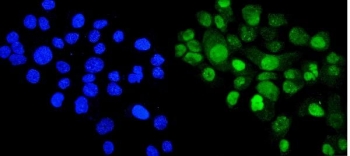
Peptidylprolyl isomerase E (cyclophilin E), also known as PPIE, is an enzyme which in humans is encoded by the PPIE gene on chromosome 1. The protein encoded by this gene is a member of the peptidyl-prolyl cis-trans isomerase (PPIase) family. PPIases catalyze the cis-trans isomerization of proline imidic peptide bonds in oligopeptides and accelerate the folding of proteins. This protein contains a highly conserved cyclophilin (CYP) domain as well as an RNA-binding domain. It was shown to possess PPIase and protein folding activities, and it also exhibits RNA-binding activity. Alternative splicing results in multiple transcript variants. A related pseudogene, which is also located on chromosome 1, has been identified.
Formulation
0.5mg/ml if reconstituted with 0.2ml sterile DI water
Host
Rabbit
Immunogen Region
A human recombinant partial protein (amino acids M1-V301) was used as the immunogen for the Cyclophilin E antibody.
Isotype
IgG
Predicted Reactivity
Human, Mouse
Reactivity
Mouse, Human
Recombinant
No
Subcellular Location
Nuclear
Antigen
Cyclophilin E
Uniprot
Q9UNP9
Format
Antigen affinity purified
Purification
Affinity purified
Storage
After reconstitution, the Cyclophilin E antibody can be stored for up to one month at 4°C. For long-term, aliquot and store at -20°C. Avoid repeated freezing and thawing.
Applications
IF, FACS, WB, Direct ELISA
Dilution
Western blot: 1-2ug/ml,Immunofluorescence: 5ug/ml,Flow cytometry: 1-3ug/million cells,Direct ELISA: 0.1-0.5ug/ml
 Loading ....