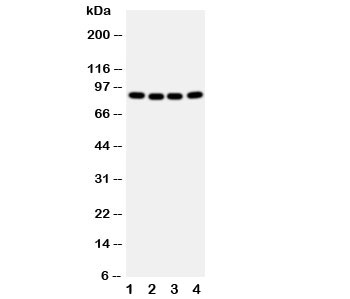
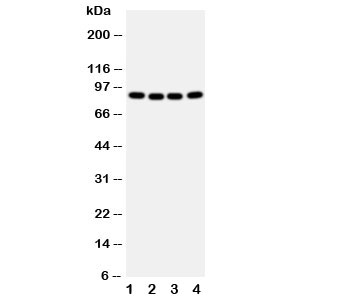
Cullin-2 is a protein that in humans is encoded by the CUL2 gene. Using immunofluorescence, it was shown that CUL2 is a cytosolic protein that can be translocated to the nucleus by VHL. By fluorescence in situ hybridization, Clifford et al.(1999) mapped the gene to 10p11.2-p11.1, a region reported to show loss of heterozygosity (LOH) in several forms of human cancer, including non-clear cell renal cell carcinoma. Pause et al.(1997) suggested that CUL2 is a candidate tumor suppressor gene, as has been proposed for CUL1 (603134). Lonergan et al.(1998) demonstrated that formation of the VBC-CUL2 complexes is linked to the regulation of hypoxia-inducible mRNAs by VHL. CUL2 is one of several proteins required for degradation of a class of RNA-binding germline proteins in somatic cells of the early blastomere.
Formulation
0.5mg/ml if reconstituted with 0.2ml sterile DI water
Host
Rabbit
Immunogen Region
An amino acid sequence from the middle region of human Cullin-2 (HECQQRMVADHLQFLHA) was used as the immunogen for this CUL2 antibody.
Isotype
IgG
Predicted Reactivity
Human, Mouse, Rat
Reactivity
Human, Mouse, Rat
Recombinant
No
Antigen
CUL2
Uniprot
Q13617
Format
Antigen affinity purified
Purification
Antigen affinity
Storage
After reconstitution, the CUL2 antibody can be stored for up to one month at 4°C. For long-term, aliquot and store at -20°C. Avoid repeated freezing and thawing.
 Loading ....