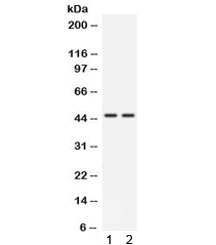
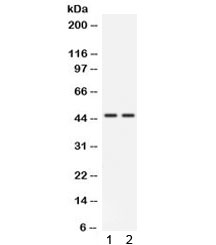
Cathepsin K, abbreviated CTSK, is an enzyme that in humans is encoded by the CTSK gene. It is mapped to 1q21. The protein encoded by this gene is a lysosomal cysteine protease involved in bone remodeling and resorption. And this protein, which is a member of the peptidase C1 protein family, is expressed predominantly in osteoclasts. Additionally, the enzyme's ability to catabolize elastin, collagen, and gelatin allow it to break down bone and cartilage. This catabolic activity is also partially responsible for the loss of lung elasticity and recoil inemphysema. Cathepsin K inhibitors, such as odanacatib, show great potential in the treatment of osteoporosis. Cathepsin K is degraded by Cathepsin S, called Controlled Cathepsin Cannibalism.
Formulation
0.5mg/ml if reconstituted with 0.2ml sterile DI water
Host
Rabbit
Immunogen Region
Amino acids 115-329 of human Cathepsin K were used as the immunogen for the CTSK antibody.
Isotype
IgG
Predicted Reactivity
Human
Reactivity
Human
Recombinant
No
Antigen
Cathepsin K
Uniprot
P43235
Format
Antigen affinity purified
Purification
Antigen affinity
Storage
After reconstitution, the CTSK antibody can be stored for up to one month at 4°C. For long-term, aliquot and store at -20°C. Avoid repeated freezing and thawing.
Applications
WB, IHC-P
Dilution
Western blot: 0.1-0.5ug/ml,Immunohistochemistry (FFPE): 0.5-1ug/ml
 Loading ....