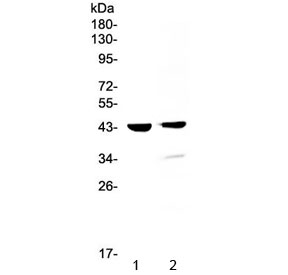
Cathepsin D is a protein that in humans is encoded by the CTSD gene. This proteinase is a member of the peptidase C1 family, having a specificity similar to but narrower than that of pepsin A. It is mapped to 11p15.5. The cDNA encodes a 412-amino acid protein with 20 and 44 amino acids in a pre- and prosegment, respectively. Cathepsin D is one of the lysosomal proteinases. It is ubiquitously expressed and is involved in proteolytic degradation, cell invasion, and apoptosis. Mutations in this gene are involved in the pathogenesis of several diseases, including breast cancer and possibly Alzheimer disease and it has been considered as a breast cancer tumor marker.
Formulation
0.5mg/ml if reconstituted with 0.2ml sterile DI water
Host
Rabbit
Immunogen Region
A mouse partial recombinant protein corresponding to amino acids K161-Q358 was used as the immunogen for the Cathepsin D / CTSD antibody.
Isotype
IgG
Predicted Reactivity
Mouse, Rat
Reactivity
Mouse, Rat
Recombinant
No
Antigen
CTSD
Uniprot
P18242
Buffer
Lyophilized from 1X PBS with 2% Trehalose and 0.025% sodium azide
Format
Antigen affinity purified
Purification
Antigen affinity purified
Storage
After reconstitution, the CTSD antibody can be stored for up to one month at 4°C. For long-term, aliquot and store at -20°C. Avoid repeated freezing and thawing.
Applications
ELISA, WB
Dilution
Western blot: 0.5-1ug/ml,Direct ELISA: 0.1-0.5ug/ml (recombinant mouse protein) (BSA-free format available)
 Loading ....