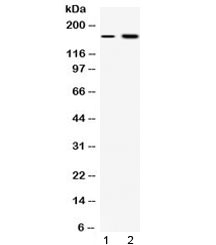
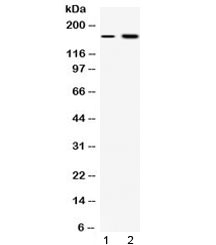
DNA excision repair protein ERCC-6 (also CS-B protein) is a protein that in humans is encoded by the ERCC6 gene. This gene encodes a DNA-binding protein that is important in transcription-coupled excision repair. The encoded protein has ATP-stimulated ATPase activity, interacts with several transcription and excision repair proteins, and may promote complex formation at DNA repair sites. Mutations in this gene are associated with Cockayne syndrome type B and cerebrooculofacioskeletal syndrome 1. Alternative splicing occurs between a splice site from exon 5 of this gene to the 3' splice site upstream of the open reading frame (ORF) of the adjacent gene, piggyback-derived-3, which activates the alternative polyadenylation site downstream of the piggyback-derived-3 ORF. The resulting transcripts encode a fusion protein that shares sequence with the product of each individual gene.
Formulation
0.5mg/ml if reconstituted with 0.2ml sterile DI water
Host
Rabbit
Immunogen Region
Amino acids 160-205 (QAATSRDINRKLDSVKRQKYNKEQQLKKITAKQKHLQAILGGAEVK) from the human protein were used as the immunogen for the CSB antibody.
Isotype
IgG
Predicted Reactivity
Human, Rat
Reactivity
Rat, Human
Recombinant
No
Subcellular Location
Nuclear
Antigen
CSB
Uniprot
Q03468
Buffer
Lyophilized from 1X PBS with 2.5% BSA and 0.025% sodium azide
Format
Antigen affinity purified
Purification
Antigen affinity
Storage
After reconstitution, the CSB antibody can be stored for up to one month at 4°C. For long-term, aliquot and store at -20°C. Avoid repeated freezing and thawing.
 Loading ....