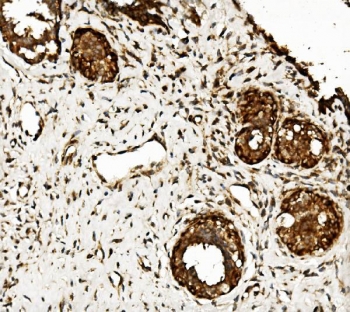
This gene belongs to the ATP-ases associated with diverse cellular activities (AAA+) superfamily. Members of this superfamily form ring-shaped homo-hexamers and have highly conserved ATPase domains that are involved in various processes including DNA replication, protein degradation and reactivation of misfolded proteins. All members of this family hydrolyze ATP through their AAA+ domains and use the energy generated through ATP hydrolysis to exert mechanical force on their substrates. In addition to an AAA+ domain, the protein encoded by this gene contains a C-terminal D2 domain, which is characteristic of the AAA+ subfamily of Caseinolytic peptidases to which this protein belongs. It cooperates with Hsp70 in the disaggregation of protein aggregates. Allelic variants of this gene are associated with 3-methylglutaconic aciduria, which causes cataracts and neutropenia. Alternative splicing results in multiple transcript variants.
Formulation
0.5mg/ml if reconstituted with 0.2ml sterile DI water
Host
Rabbit
Immunogen Region
Recombinant human protein (amino acids Q438-I707) was used as the immunogen for the CLPB antibody.
Isotype
IgG
Predicted Reactivity
Human, Mouse, Rat
Reactivity
Rat, Mouse, Human
Recombinant
No
Subcellular Location
Cytoplasmic
Antigen
CLPB
Uniprot
Q9H078
Buffer
Lyophilized from 1X PBS with 2% Trehalose and 0.025% sodium azide
Format
Antigen affinity purified
Purification
Affinity purified
Storage
After reconstitution, the CLPB antibody can be stored for up to one month at 4°C. For long-term, aliquot and store at -20°C. Avoid repeated freezing and thawing.
Applications
Direct ELISA, FACS, IF, IHC-P, WB
Dilution
Western blot: 0.5-1ug/ml,Immunohistochemistry: 1-2ug/ml,Immunofluorescence: 2-4ug/ml,Flow cytometry: 1-3ug/million cells,Direct ELISA: 0.1-0.5ug/ml
 Loading ....