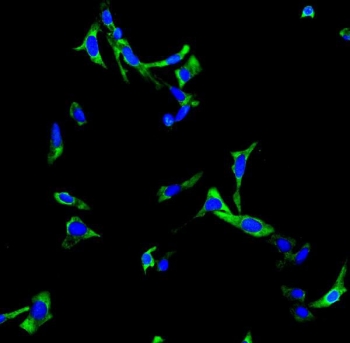
Choline acetyltransferase (commonly abbreviated as ChAT or CAT) is a transferase enzyme responsible for the synthesis of the neurotransmitter acetylcholine. In humans, the choline acetyltransferase enzyme is encoded by the CHAT gene. This gene product is a characteristic feature of cholinergic neurons, and changes in these neurons may explain some of the symptoms of Alzheimer's disease. Polymorphisms in this gene have been associated with Alzheimer's disease and mild cognitive impairment. Mutations in this gene are associated with congenital myasthenic syndrome associated with episodic apnea. Multiple transcript variants encoding different isoforms have been found for this gene, and some of these variants have been shown to encode more than one isoform.
Formulation
0.5mg/ml if reconstituted with 0.2ml sterile DI water
Host
Rabbit
Immunogen Region
Recombinant human protein (amino acids T25-K731) was used as the immunogen for the ChAT antibody.
Isotype
IgG
Predicted Reactivity
Human, Mouse, Rat
Reactivity
Rat, Mouse, Human
Recombinant
No
Subcellular Location
Nuclear, cytoplasmic
Antigen
ChAT
Uniprot
P28329
Buffer
Lyophilized from 1X PBS with 2% Trehalose and 0.025% sodium azide
Format
Antigen affinity purified
Purification
Affinity purified
Storage
After reconstitution, the ChAT antibody can be stored for up to one month at 4°C. For long-term, aliquot and store at -20°C. Avoid repeated freezing and thawing.
Applications
Direct ELISA, IF, FACS, IHC-P, WB
Dilution
Western blot: 0.5-1ug/ml,Immunohistochemistry: 1-2ug/ml,Flow cytometry: 1-3ug/million cells,Immunofluorescence: 2-4ug/ml,Direct ELISA: 0.1-0.5ug/ml
 Loading ....