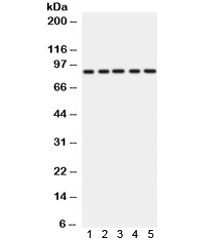
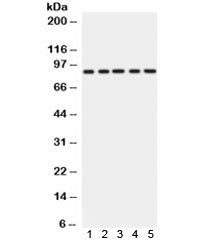
CD36 (cluster of differentiation 36), also known as FAT (fatty acid translocase), FAT/CD36, SCARB3, GP88, glycoprotein IV (gpIV), and glycoprotein IIIb (gpIIIb), is anintegral membrane protein found on the surface of many cell types in vertebrate animals. It is a member of the class B scavenger receptor family of cell surface proteins. It is mapped to 7q21.11. And CD36 binds many ligands including collagen, thrombospondin, erythrocytes parasitized with Plasmodium falciparum, oxidized low density lipoprotein, native lipoproteins, oxidized phospholipids, and long-chain fatty acids. In addition, CD36 function in long-chain fatty acid uptake and signaling can be irreversibly inhibited by sulfo-N-succinimidyl oleate (SSO), which binds lysine 164 within a hydrophobic pocked shared by several CD36 ligands, e.g. fatty acid and oxLDL.
Formulation
0.5mg/ml if reconstituted with 0.2ml sterile DI water
Host
Rabbit
Immunogen Region
Amino acids DLLIQKTIKKQVVLEEGTIAFKNWVKTGTEVYRQFW of human CD36 were used as the immunogen for the CD36 antibody.
Isotype
IgG
Predicted Reactivity
Human, Mouse, Rat
Reactivity
Human, Mouse, Rat
Recombinant
No
Subcellular Location
Cell membrane
Antigen
CD36
Uniprot
P16671
Format
Antigen affinity purified
Purification
Antigen affinity
Storage
After reconstitution, the CD36 antibody can be stored for up to one month at 4°C. For long-term, aliquot and store at -20°C. Avoid repeated freezing and thawing.
Applications
IHC-P, WB
Dilution
Western blot: 0.1-0.5ug/ml,Immunohistochemistry (FFPE): 0.5-1ug/ml
 Loading ....