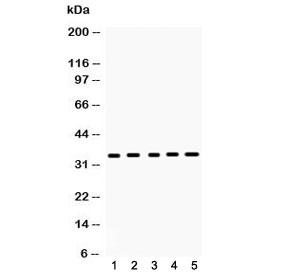
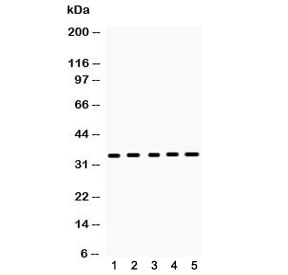
Copper chaperone for superoxide dismutase (CCS, SOD4) is a metalloprotein that is responsible for the delivery of Cu to superoxide dismutase (SOD1). In humans the protein is encoded by the CCS gene. And this gene is mapped to chromosome 11q13 by fluorescence in situ hybridization. The CCS protein is present in mammals and most eukaryotes including yeast. The structure of CCS is composed of three distinct domains that are necessary for its function. Although CCS is important for many organisms, there are CCS independent pathways for SOD1, and many species lack CCS all together, such as C. elegans.
Formulation
0.5mg/ml if reconstituted with 0.2ml sterile DI water
Host
Rabbit
Immunogen Region
Amino acids 174-209 (DADGRAIFRMEDEQLKVWDVIGRSLIIDEGEDDLGR) from the human protein were used as the immunogen for the CCS antibody.
Isotype
IgG
Predicted Reactivity
Human, Mouse, Rat
Reactivity
Human, Mouse, Rat
Recombinant
No
Subcellular Location
Cytoplasmic, nuclear
Antigen
CCS
Uniprot
O14618
Buffer
Lyophilized from 1X PBS with 2.5% BSA, 0.025% sodium azide
Format
Antigen affinity purified
Purification
Antigen affinity
Storage
After reconstitution, the CCS antibody can be stored for up to one month at 4°C. For long-term, aliquot and store at -20°C. Avoid repeated freezing and thawing.
Applications
IHC-P, WB
Dilution
Western blot: 0.5-1ug/ml,Immunohistochemistry (FFPE): 1-2ug/ml
 Loading ....