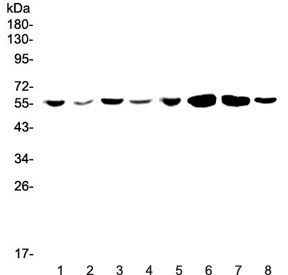
C-C chemokine receptor type 3, also called CCR3 or CKR3 is a protein that in humans is encoded by the CCR3 gene. The protein encoded by this gene is a receptor for C-C type chemokines. It belongs to family 1 of the G protein-coupled receptors. This gene and seven other chemokine receptor genes form a chemokine receptor gene cluster on the chromosomal region 3p21. This receptor binds and responds to a variety of chemokines, including eotaxin (CCL11), eotaxin-3 (CCL26), MCP-3 (CCL7), MCP-4 (CCL13), and RANTES (CCL5). It is highly expressed in eosinophils and basophils, and is also detected in TH1 and TH2 cells, as well as in airway epithelial cells. This receptor may contribute to the accumulation and activation of eosinophils and other inflammatory cells in the allergic airway. It is also known to be an entry co-receptor for HIV-1. Alternatively spliced transcript variants have been described.
Formulation
0.5mg/ml if reconstituted with 0.2ml sterile DI water
Host
Rabbit
Immunogen Region
Amino acids MTTSLDTVETFGTTSYYDDVGLLCEKADTRALMA were used as the immunogen for the CCR3 antibody.
Isotype
IgG
Predicted Reactivity
Human, Mouse, Rat
Reactivity
Human, Mouse, Rat
Recombinant
No
Subcellular Location
Cell membrane
Antigen
CCR3
Uniprot
P51677
Buffer
Lyophilized from 1X PBS with 2% Trehalose and 0.025% sodium azide
Format
Antigen affinity purified
Purification
Antigen affinity purified
Storage
After reconstitution, the CCR3 antibody can be stored for up to one month at 4°C. For long-term, aliquot and store at -20°C. Avoid repeated freezing and thawing.
Applications
FACS, WB
Dilution
Western blot: 0.5-1ug/ml,Flow cytometry: 1-3ug/million cells
 Loading ....