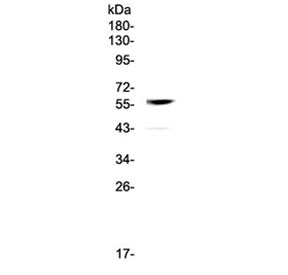
The cannabinoid receptor type 1, often abbreviated as CB1, is a G protein-coupled cannabinoid receptor located primarily in the central and peripheral nervous system. This gene encodes one of two cannabinoid receptors. The cannabinoids, principally delta-9-tetrahydrocannabinol and synthetic analogs, are psychoactive ingredients of marijuana. The cannabinoid receptors are members of the guanine-nucleotide-binding protein (G-protein) coupled receptor family, which inhibit adenylate cyclase activity in a dose-dependent, stereoselective and pertussis toxin-sensitive manner. The two receptors have been found to be involved in the cannabinoid-induced CNS effects (including alterations in mood and cognition) experienced by users of marijuana. Multiple transcript variants encoding two different protein isoforms have been described for this gene.
Formulation
0.5mg/ml if reconstituted with 0.2ml sterile DI water
Host
Rabbit
Immunogen Region
A recombinant human protein corresponding to amino acids M1-Q75 was used as the immunogen for the CB1 antibody.
Isotype
IgG
Predicted Reactivity
Human, Mouse, Rat
Reactivity
Mouse, Rat, Human
Recombinant
No
Subcellular Location
Cell membrane
Antigen
CB1
Uniprot
P21554
Buffer
Lyophilized from 1X PBS with 2% Trehalose and 0.025% sodium azide
Format
Antigen affinity purified
Purification
Antigen affinity purified
Storage
After reconstitution, the CB1 antibody can be stored for up to one month at 4°C. For long-term, aliquot and store at -20°C. Avoid repeated freezing and thawing.
Applications
FACS, IHC-P, WB, ELISA
Dilution
Western blot: 0.5-1ug/ml, IHC (FFPE): 01-2ug/ml,Flow cytometry: 1-3ug/million cells, Direct ELISA: 0.1-0.5ug/ml
 Loading ....