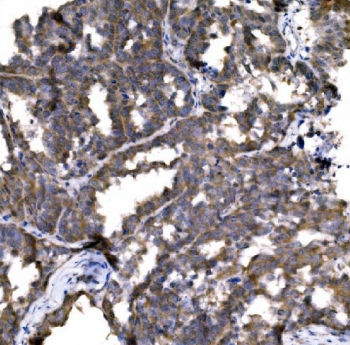
CASP9 is also known as MCH6 or APAF3. This gene encodes a member of the cysteine-aspartic acid protease (caspase) family. Sequential activation of caspases plays a central role in the execution-phase of cell apoptosis. Caspases exist as inactive proenzymes which undergo proteolytic processing at conserved aspartic residues to produce two subunits, large and small, that dimerize to form the active enzyme. This protein can undergo autoproteolytic processing and activation by the apoptosome, a protein complex of cytochrome c and the apoptotic peptidase activating factor 1; this step is thought to be one of the earliest in the caspase activation cascade. This protein is thought to play a central role in apoptosis and to be a tumor suppressor. Alternative splicing results in multiple transcript variants.
Formulation
0.5mg/ml if reconstituted with 0.2ml sterile DI water
Host
Rabbit
Immunogen Region
Recombinant human protein (amino acids E18-S416) was used as the immunogen for the CASP9 antibody.
Isotype
IgG
Predicted Reactivity
Human
Reactivity
Human
Recombinant
No
Subcellular Location
Cytoplasmic, nuclear
Antigen
CASP9
Uniprot
P55211
Buffer
Lyophilized from 1X PBS with 2% Trehalose
Format
Purified
Purification
Antigen affinity purified
Storage
After reconstitution, the CASP9 antibody can be stored for up to one month at 4°C. For long-term, aliquot and store at -20°C. Avoid repeated freezing and thawing.
Applications
Direct ELISA, FACS, IHC-P, WB
Dilution
Western blot: 0.5-1ug/ml,Immunohistochemistry (FFPE): 2-5ug/ml,Flow cytometry: 1-3ug/million cells,Direct ELISA: 0.1-0.5ug/ml
 Loading ....