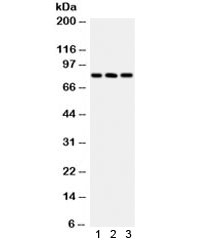
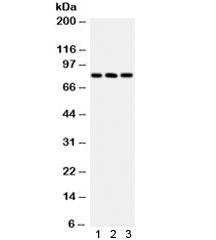
Calcineurin A is also known as PPP3CA. It is mapped to 4q24. Semsarian et al. (1999) and Musaro et al. (1999) independently showed that IGF1stimulates skeletal muscle hypertrophy and a switch to glycolytic metabolism by activating calcineurin A and inducing the nuclear translocation of transcription factor NFATC1. Semsarian et al. (1999) found that hypertrophy was suppressed by the calcineurin inhibitors cyclosporin A or FK506, but not by inhibitors of the MAP kinase or phosphatidylinositol-3-OH kinase pathways. Musaro et al. (1999) showed that expression of a dominant-negative calcineurin mutant also repressed myocyte differentiation and hypertrophy. Musaro et al. (1999) demonstrated that either IGF1 or activated calcineurin induces expression of transcription factor GATA2, which accumulates in a subset of myocyte nuclei, where it associates with calcineurin and a specific dephosphorylated isoform of NFATC1.
Formulation
0.5mg/ml if reconstituted with 0.2ml sterile DI water
Host
Rabbit
Immunogen Region
Amino acids DAMPSDANLNSINKALTSETNGTDSNGSNSSNIQ of human Calcineurin A were used as the immunogen for the Calcineurin A antibody.
Isotype
IgG
Predicted Reactivity
Human
Reactivity
Human
Recombinant
No
Antigen
Calcineurin
Uniprot
Q08209
Format
Antigen affinity purified
Purification
Antigen affinity
Storage
After reconstitution, the Calcineurin A antibody can be stored for up to one month at 4°C. For long-term, aliquot and store at -20°C. Avoid repeated freezing and thawing.
 Loading ....