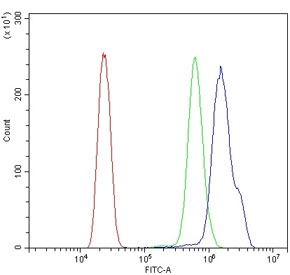
BRCA1, mapped to 17q21.3, is also known as BRCC1. This gene encodes a nuclear phosphoprotein that plays a role in maintaining genomic stability, and it also acts as a tumor suppressor. The encoded protein combines with other tumor suppressors, DNA damage sensors, and signal transducers to form a large multi-subunit protein complex known as the BRCA1-associated genome surveillance complex (BASC). BRCA1 product associates with RNA polymerase II, and through the C-terminal domain, also interacts with histone deacetylase complexes. This protein thus plays a role in transcription, DNA repair of double-stranded breaks, and recombination. In addition to it, BRCA1 may normally serve as a negative regulator of mammary epithelial cell growth and that this function is compromised in breast cancer either by direct mutation or by alterations in gene expression.
Formulation
0.5mg/ml if reconstituted with 0.2ml sterile DI water
Host
Rabbit
Immunogen Region
Recombinant human protein (amino acids Q1467-Y1863) was used as the immunogen for the BRCA1 antibody.
Isotype
IgG
Predicted Reactivity
Human
Reactivity
Human
Recombinant
No
Antigen
BRCA1
Uniprot
P38398
Buffer
Lyophilized from 1X PBS with 2% Trehalose
Format
Purified
Purification
Antigen affinity purified
Storage
After reconstitution, the BRCA1 antibody can be stored for up to one month at 4°C. For long-term, aliquot and store at -20°C. Avoid repeated freezing and thawing.
Applications
Direct ELISA, FACS, WB
Dilution
Western blot: 0.5-1ug/ml,Flow cytometry: 1-3ug/million cells,Direct ELISA: 0.1-0.5ug/ml
 Loading ....