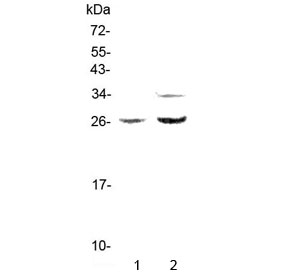
Betacellulin is a protein that in humans is encoded by the BTC gene located on chromosome 4 at locus 4q13-q21. This gene encodes a member of the epidermal growth factor (EGF) family of proteins. Alternative splicing results in multiple transcript variants, at least one of which encodes a preproprotein that is proteolytically processed to generate the secreted growth factor. A secreted form and a membrane-anchored form of this protein bind to multiple different EGF receptors. This protein promotes pancreatic cell proliferation and insulin secretion, as well as retinal vascular permeability. Mutations in this gene may be associated with type 2 diabetes in human patients.
Formulation
0.5mg/ml if reconstituted with 0.2ml sterile DI water
Host
Rabbit
Immunogen Region
A rat partial recombinant protein corresponding to amino acids D32-A177 was used as the immunogen for the Betacellulin antibody.
Isotype
IgG
Predicted Reactivity
Mouse, Rat
Reactivity
Mouse, Rat
Recombinant
No
Antigen
Betacellulin
Uniprot
Q9JJM4
Buffer
Lyophilized from 1X PBS with 2% Trehalose and 0.025% sodium azide
Format
Antigen affinity purified
Purification
Antigen affinity purified
Storage
After reconstitution, the Betacellulin antibody can be stored for up to one month at 4°C. For long-term, aliquot and store at -20°C. Avoid repeated freezing and thawing.
Applications
ELISA, IHC-P, WB
Dilution
Western blot: 0.5-1ug/ml,Immunohistochemistry (FFPE): 1-2ug/ml,Direct ELISA: 0.1-0.5ug/ml (recombinant rat protein) (BSA-free format available)
 Loading ....