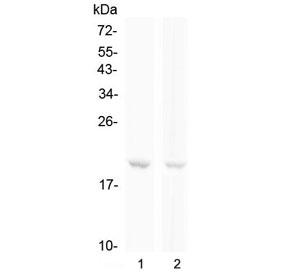
B-cell maturation antigen (BCMA or BCM), also known as tumor necrosis factor receptor superfamily member 17 (TNFRSF17), is a protein that in humans is encoded by the TNFRSF17 gene. The protein encoded by this gene is a member of the TNF-receptor superfamily. This receptor is preferentially expressed in mature B lymphocytes, and may be important for B cell development and autoimmune response. This receptor has been shown to specifically bind to the tumor necrosis factor (ligand) superfamily, member 13b (TNFSF13B/TALL-1/BAFF), and to lead to NF-kappaB and MAPK8/JNK activation. This receptor also binds to various TRAF family members, and thus may transduce signals for cell survival and proliferation.
Formulation
0.5mg/ml if reconstituted with 0.2ml sterile DI water
Host
Rabbit
Immunogen Region
A recombinant human protein corresponding to amino acids M1-A54 was used as the immunogen for the BCMA antibody.
Isotype
IgG
Predicted Reactivity
Human
Reactivity
Human
Recombinant
No
Subcellular Location
Cell membrane, cytoplasm
Antigen
BCMA
Uniprot
Q02223
Buffer
Lyophilized from 1X PBS with 2% Trehalose
Format
Antigen affinity purified
Purification
Antigen affinity purified
Storage
After reconstitution, the BCMA antibody can be stored for up to one month at 4°C. For long-term, aliquot and store at -20°C. Avoid repeated freezing and thawing.
Applications
ELISA, IHC-P, WB
Dilution
Western blot: 0.5-1ug/ml, Immunohistochemistry (FFPE): 1-2ug/ml, ELISA (Capture): 1-5ug/ml
 Loading ....