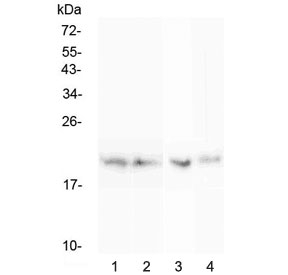
B-cell maturation antigen (BCMA or BCM), also known as tumor necrosis factor receptor superfamily member 17 (TNFRSF17), is a protein that in humans is encoded by the TNFRSF17 gene. The protein encoded by this gene is a member of the TNF-receptor superfamily. This receptor is preferentially expressed in mature B lymphocytes, and may be important for B cell development and autoimmune response. This receptor has been shown to specifically bind to the tumor necrosis factor (ligand) superfamily, member 13b (TNFSF13B/TALL-1/BAFF), and to lead to NF-kappaB and MAPK8/JNK activation. This receptor also binds to various TRAF family members, and thus may transduce signals for cell survival and proliferation.
Formulation
0.5mg/ml if reconstituted with 0.2ml sterile DI water
Host
Rabbit
Immunogen Region
A recombinant rat protein corresponding to amino acids M1-T49 was used as the immunogen for the BCMA antibody.
Isotype
IgG
Predicted Reactivity
Rat
Reactivity
Rat
Recombinant
No
Subcellular Location
Cell membrane; cytoplasm
Antigen
BCMA
Uniprot
D3ZKQ8
Buffer
Lyophilized from 1X PBS with 2% Trehalose and 0.025% sodium azide
Format
Antigen affinity purified
Purification
Antigen affinity purified
Storage
After reconstitution, the BCMA antibody can be stored for up to one month at 4°C. For long-term, aliquot and store at -20°C. Avoid repeated freezing and thawing.
Applications
WB, ELISA
Dilution
Western blot: 0.5-1ug/ml,ELISA (Capture): 1-5ug/ml
 Loading ....