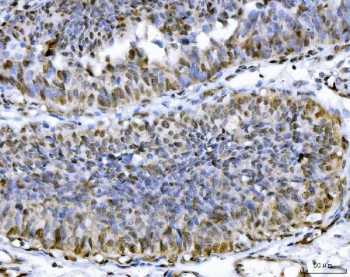
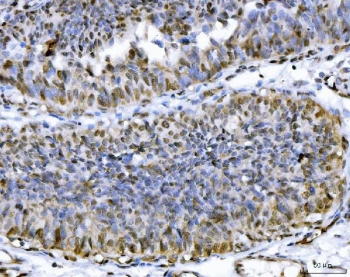
ATP citrate lyase, aslo known as ACLY, is an enzyme that in animals represents an important step in fatty acid biosynthesis. ATP citrate lyase is the primary enzyme responsible for the synthesis of cytosolic acetyl-CoA in many tissues. The enzyme is a tetramer of apparently identical subunits. The product, acetyl-CoA, in animals serves several important biosynthetic pathways, including lipogenesis and cholesterogenesis. It is activated by insulin. In nervous tissue, ATP citrate-lyase may be involved in the biosynthesis of acetylcholine. In plants, ATP citrate lyase generates the acetyl-CoA for cytosolically-synthesized metabolites.
Formulation
0.5mg/ml if reconstituted with 0.2ml sterile DI water
Host
Rabbit
Immunogen Region
Amino acids M1-I180 from the human protein were used as the immunogen for the ATP Citrate Lyase antibody.
Isotype
IgG
Predicted Reactivity
Human, Rat
Reactivity
Rat, Human
Recombinant
No
Subcellular Location
Cytoplasmic, nuclear
Antigen
ACL
Uniprot
P53396
Buffer
Lyophilized from 1X PBS with 2.5% BSA and 0.025% sodium azide
Format
Antigen affinity purified
Purification
Antigen affinity
Storage
After reconstitution, the ATP Citrate Lyase antibody can be stored for up to one month at 4°C. For long-term, aliquot and store at -20°C. Avoid repeated freezing and thawing.
Applications
IHC-P, ICC, WB, FACS
Dilution
Western blot: 0.5-1ug/ml,Immunohistochemistry (FFPE): 1-2ug/ml,Immunocytochemistry (FFPE): 2-4ug/ml,Flow cytometry: 1-3ug/million cells
 Loading ....