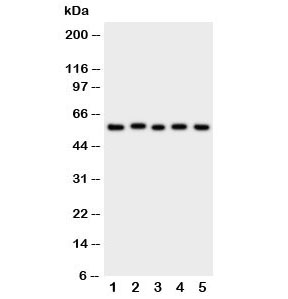
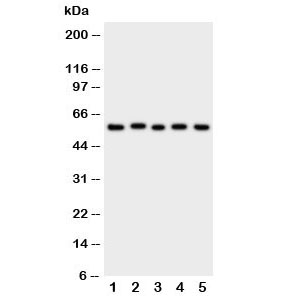
Acid-Sensing Ion Channel 3, also known as Testis sodium channel (TNAC1) or Dorsal root acid-sensing ion channel (DRASIC), is a protein that in humans is encoded by the ASIC3 gene. ASIC3 belongs to a family of acid-sensing channel proteins that are structurally related to epithelial sodium channel proteins and support acid-activated membrane currents. By radiation hybrid analysis, de Weille et al.(1998) mapped the gene to chromosome 7q35. De Weille et al.(1998) found that the human protein supported an H(+)-gated cation current in COS cells with kinetics similar to those of the rat protein. Babinski et al. (1999) expressed homomeric human ASIC3 channels in Xenopus oocytes and found that rapid reduction in extracellular pH resulted in a biphasic response characterized by a fast and rapidly desensitizing current followed by a slow and sustained current that returned to baseline only on return to physiologic pH.
Formulation
0.5mg/ml if reconstituted with 0.2ml sterile DI water
Host
Rabbit
Immunogen Region
An amino acid sequence from the N-terminus of human Acid-Sensing Ion Channel 3 (FLYQVAERVRYYREFHHQ) was used as the immunogen for this ASIC3 antibody.
Isotype
IgG
Predicted Reactivity
Human, Mouse, Rat
Reactivity
Human, Mouse, Rat
Recombinant
No
Antigen
ASIC3
Uniprot
Q9UHC3
Format
Antigen affinity purified
Purification
Antigen affinity
Storage
After reconstitution, the ASIC3 antibody can be stored for up to one month at 4°C. For long-term, aliquot and store at -20°C. Avoid repeated freezing and thawing.
Applications
FACS, WB
Dilution
Western blot: 0.5-1ug/ml,Flow cytometry: 1-3ug/million cells
 Loading ....