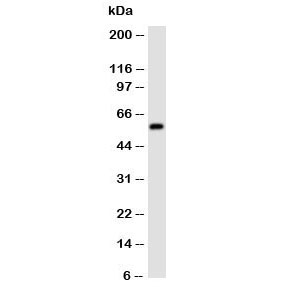
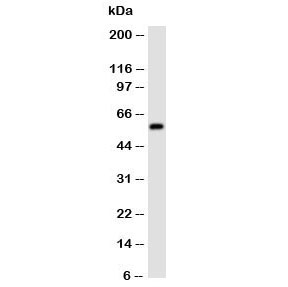
Aromatase is an enzyme responsible for a key step in the biosynthesis of estrogens. It is a member of the cytochrome P450 superfamily, which are monooxygenases that catalyze many reactions involved in steroidogenesis. In particular, aromatase is responsible for the aromatization of androgens into estrogens. The CYP19 gene spans at least 70 kb of genomic DNA and contains 10 exons. By in situ hybridization, the ARO gene is mapped to 15q21.1. The aromatase enzyme can be found in many tissues including gonads, brain, adipose tissue, placenta, blood vessels, skin, bone, and endometrium, as well as in tissue of endometriosis, uterine fibroids, breast cancer, and endometrial cancer. It is an important factor in sexual development. Some bodybuilders taking steroids also take antiaromatase supplements to prevent excess testosterone conversion into estrogens, which can cause gynecomastia.
Formulation
0.5mg/ml if reconstituted with 0.2ml sterile DI water
Host
Rabbit
Immunogen Region
An amino acid sequence from the C-terminus of human Aromatase (KNMLEMIFTPRNSDRCLEH) was used as the immunogen for this Aromatase antibody.
Isotype
IgG
Predicted Reactivity
Human
Reactivity
Human
Recombinant
No
Antigen
Aromatase
Uniprot
P11511
Format
Antigen affinity purified
Purification
Antigen affinity
Storage
After reconstitution, the Aromatase antibody can be stored for up to one month at 4°C. For long-term, aliquot and store at -20°C. Avoid repeated freezing and thawing.
Applications
WB, IHC-P
Dilution
Western blot: 0.5-1ug/ml,Immunohistochemistry (FFPE): 0.5-1ug/ml
 Loading ....