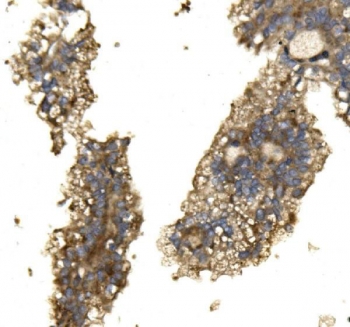
ARG2 (arginase, type II) encodes a 355-amino acid polypeptide. Using Northern blotting and RT-PCR, Vockley et al.(1996) found that ARG 2is expressed as a 1.5-kb mRNA in a wide variety of tissues, with highest levels of expression in prostate, brain, and kidney. By PCR analysis of somatic cell hybrid panels, fluorescence in situ hybridization, and radiation hybrid analysis, the ARG2 gene is mapped to 14q24.1-q24.3. ARG2 may be inducible and may be essential in the regulation of nitric oxide synthesis by modulating local arginine concentrations. Gotoh et al.(1996)showed that ARG2 mRNA and nitric oxide synthase (NOS) mRNA were coinduced by lipopolysaccharide in a macrophage-like cell line. Arginase II has been implicated in the regulation of the arginine/ornithine concentrations in the cell. The mitochondrial location of ARG2 and its coinduction with ornithine aminotransferase and involvement with proline biosynthesis in lactating rat mammary gland had led to the inference that ARG2 is involved in biosynthetic functions, as opposed to the metabolic ones of the urea cycle.
Formulation
0.5mg/ml if reconstituted with 0.2ml sterile DI water
Host
Rabbit
Immunogen Region
Recombinant human protein (amino acids M1-I354) was used as the immunogen for the Arginase 2 antibody.
Isotype
IgG
Predicted Reactivity
Human, Mouse, Rat
Reactivity
Rat, Mouse, Human
Recombinant
No
Subcellular Location
Cytoplasmic
Antigen
Arginase 2
Uniprot
P78540
Buffer
Lyophilized from 1X PBS with 2% Trehalose and 0.025% sodium azide
Format
Antigen affinity purified
Purification
Affinity purified
Storage
After reconstitution, the Arginase 2 antibody can be stored for up to one month at 4°C. For long-term, aliquot and store at -20°C. Avoid repeated freezing and thawing.
Applications
Direct ELISA, FACS, IF, IHC-P, WB
Dilution
Western blot: 0.5-1ug/ml,Immunohistochemistry: 1-2ug/ml,Immunofluorescence: 2-4ug/ml,Flow cytometry: 1-3ug/million cells,Direct ELISA: 0.1-0.5ug/ml
 Loading ....