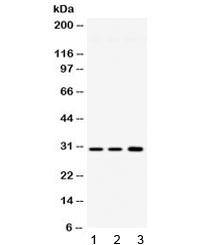
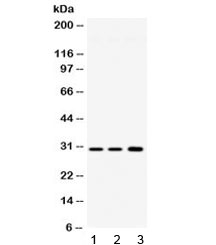
AQP11 has a unique asparagine-proline-alanine (NPA) box distinct from those of other AQPs, suggesting a different pore structure and function. Using Northern blot analysis, they detected highest expression of mouse Aqp11 in testis, followed by liver and kidney. Expression was much weaker in heart, brain, and muscle. Western blot analysis of mouse kidney membrane fractions detected Aqp11 at an apparent molecular mass of 26 kD, lower than the calculated molecular mass of 30 kD. Immunohistochemical analysis localized Aqp11 to mouse renal proximal tubule cells, where it showed a perinuclear distribution. Fluorescence-tagged Aqp11 localized with an endoplasmic reticulum marker.
Formulation
0.5mg/ml if reconstituted with 0.2ml sterile DI water
Host
Rabbit
Immunogen Region
Amino acids 35-70 (ARQQLHRPVAHAFVLEFLATFQLCCCTHELQLLSEQ from the human protein were used as the immunogen for the AQP11 antibody.
Isotype
IgG
Predicted Reactivity
Human, Mouse, Rat
Reactivity
Human, Mouse, Rat
Recombinant
No
Subcellular Location
Cytoplasmic
Antigen
AQP11
Uniprot
Q8NBQ7
Buffer
Lyophilized from 1X PBS with 2.5% BSA and 0.025% sodium azide
Format
Antigen affinity purified
Purification
Antigen affinity
Storage
After reconstitution, the AQP11 antibody can be stored for up to one month at 4°C. For long-term, aliquot and store at -20°C. Avoid repeated freezing and thawing.
 Loading ....