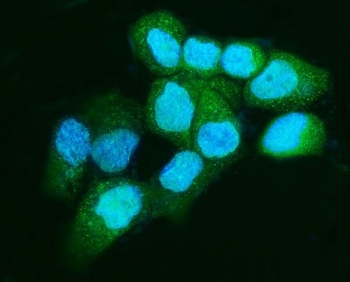
Anaphase-promoting complex subunit 5 is an enzyme that in humans is encoded by the ANAPC5 gene. This gene encodes a tetratricopeptide repeat-containing component of the anaphase promoting complex/cyclosome (APC/C), a large E3 ubiquitin ligase that controls cell cycle progression by targeting a number of cell cycle regulators such as B-type cyclins for 26S proteasome-mediated degradation through ubiquitination. The encoded protein is required for the proper ubiquitination function of APC/C and for the interaction of APC/C with transcription coactivators. It also interacts with polyA binding protein and represses internal ribosome entry site-mediated translation. Multiple transcript variants encoding different isoforms have been found for this gene. These differences cause translation initiation at a downstream AUG and result in a shorter protein (isoform b), compared to isoform a.
Formulation
0.5mg/ml if reconstituted with 0.2ml sterile DI water
Host
Rabbit
Immunogen Region
A human recombinant partial protein (amino acids M1-D266) was used as the immunogen for the Apc5 antibody.
Isotype
IgG
Predicted Reactivity
Human
Reactivity
Human
Recombinant
No
Antigen
Apc5
Uniprot
Q9UJX4
Format
Antigen affinity purified
Purification
Affinity purified
Storage
After reconstitution, the Apc5 antibody can be stored for up to one month at 4°C. For long-term, aliquot and store at -20°C. Avoid repeated freezing and thawing.
Applications
Direct ELISA, FACS, IF, WB
Dilution
Western blot: 1-2ug/ml,Immunofluorescence: 5ug/ml,Flow cytometry: 1-3ug/million cells,Direct ELISA: 0.1-0.5ug/ml
 Loading ....