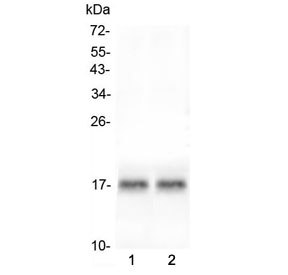
Atrial natriuretic factor (ANF), also known as Atrial natriuretic peptide (ANP), NPPA or PND, is a powerful vasodilator, and a protein (polypeptide) hormone secreted by heart muscle cells. This gene is mapped to 1p36.22. It is involved in the homeostatic control of body water, sodium, potassium and fat (adipose tissue). ANF is released by muscle cells in the upper chambers (atria) of the heart (atrial myocytes) in response to high blood volume. It acts to reduce the water, sodium and adipose loads on the circulatory system, thereby reducing blood pressure. ANF has exactly the opposite function of the aldosterone secreted by the zona glomerulosa in regard to its effect on sodium in the kidney--that is, aldosterone stimulates sodium retention and it generates sodium loss.
Formulation
0.5mg/ml if reconstituted with 0.2ml sterile DI water
Host
Rabbit
Immunogen Region
Mouse ANP/ANF recombinant protein (amino acids N25-R122) was used as the immunogen for the ANF antibody.
Isotype
IgG
Predicted Reactivity
Mouse, Rat
Reactivity
Mouse, Rat
Recombinant
No
Subcellular Location
Secreted, intracellular
Antigen
Atrial Natriuretic Peptide/Factor
Uniprot
P05125
Buffer
Lyophilized from 1X PBS with 2% Trehalose and 0.025% sodium azide
Format
Antigen affinity purified
Purification
Antigen affinity
Storage
After reconstitution, the ANF antibody can be stored for up to one month at 4°C. For long-term, aliquot and store at -20°C. Avoid repeated freezing and thawing.
Applications
ELISA, IHC-P, WB
Dilution
Western blot: 0.5-1ug/ml,Immunohistochemistry (FFPE): 1-2ug/ml,Direct ELISA: 0.1-0.5ug/ml (recombinant mouse protein)
 Loading ....