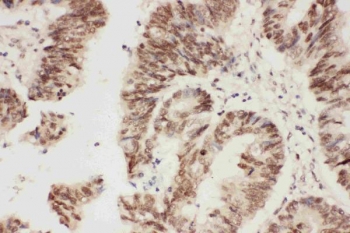
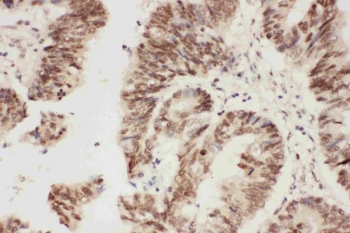
Anaplastic lymphoma kinase also known as CD246 (cluster of differentiation 246), is an enzyme that in humans is encoded by the ALK gene. Expressed in the small intestine, testis, and brain but not in normal lymphoid cells, ALK shows greatest sequence similarity to the insulin receptor subfamily of kinases. It plays an important role in the development of the brain and exerts its effects on specific neurons in the nervous system. The deduced amino acid sequences reveal that ALK is a novel receptor tyrosine kinase having a putative transmembrane domain and an extracellular domain. In Drosophila, localized Jeb activates Alk and the downstream Ras/mitogen-activated protein kinase cascade to specify a select group of visceral muscle precursors as muscle-patterning pioneers. Functional RNA interference screening on a set of these transcriptional targets revealed that CEBPB and BCL2A1 were absolutely necessary to induce cell transformation and/or to sustain growth and survival of ALK-positive ALCL cells. One particularly informative case presented a high-level gene amplification that was strictly limited to ALK, indicating that this gene may contribute on its own to neuroblastoma development. Mutated ALK proteins were overexpressed, hyperphosphorylated, and showed constitutive kinase activity. The knockdown of expression in ALK-mutated cells, but also in cell lines overexpressing the wildtype protein, led to a marked decrease of cell proliferation.
Formulation
0.5mg/ml if reconstituted with 0.2ml sterile DI water
Host
Rabbit
Immunogen Region
An amino acid sequence from the C-terminus of human ALK (LFRLRHFPCGNVNYGYQQQ) was used as the immunogen for this ALK antibody (100% homologous in human, mouse and rat).
Isotype
IgG
Predicted Reactivity
Human, Mouse, Rat
Reactivity
Human, Mouse, Rat
Recombinant
No
Antigen
ALK
Uniprot
Q9UM73
Format
Antigen affinity purified
Purification
Antigen affinity
Storage
After reconstitution, the ALK antibody can be stored for up to one month at 4°C. For long-term, aliquot and store at -20°C. Avoid repeated freezing and thawing.
Applications
IHC-P, WB
Dilution
Western blot: 0.5-1ug/ml,Immunohistochemistry (FFPE): 0.5-1ug/ml
 Loading ....