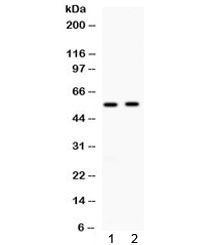
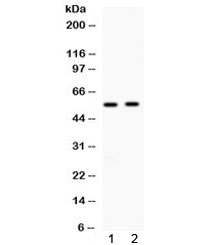
Fatty aldehyde dehydrogenase (or Long-chain-aldehyde dehydrogenase) is an aldehyde dehydrogenase enzyme that in human is encoded in the ALDH3A2 gene on chromosome 17. ALDH3A2 catalyzes the oxidation of long-chain aliphatic aldehydes into fatty acids. It is known to act on a variety of both saturated and unsaturated aliphatic aldehydes between 6 to 24 carbons in length, as well as dihydrophytal, a 20-carbon branched chain aldehyde. It requires NAD+ as a co-factor. The encoded enzyme is responsible for conversion of the sphingosine 1-phosphate (S1P) degradation product hexadecenal to hexadecenoic acid. ALD3H2 is expressed in the human liver and has been found to localize the microsome fraction inside the cell.
Formulation
0.5mg/ml if reconstituted with 0.2ml sterile DI water
Host
Rabbit
Immunogen Region
Amino acids M1-Q100 were used as the immunogen for the ALDH3A2 antibody.
Isotype
IgG
Predicted Reactivity
Human, Rat
Reactivity
Human, Rat
Recombinant
No
Subcellular Location
Cytoplasmic
Antigen
ALDH3A2
Uniprot
P51648
Buffer
Lyophilized from 1X PBS with 2.5% BSA and 0.025% sodium azide
Format
Antigen affinity purified
Purification
Antigen affinity
Storage
Prior to reconstitution, store at 4°C. After reconstitution, the ALDH3A2 antibody can be stored for up to one month at 4°C. For long-term, aliquot and store at -20°C. Avoid repeated freezing and thawing.
Applications
IHC-P, WB
Dilution
Western blot: 0.5-1ug/ml,Immunohistochemistry (FFPE): 1-2ug/ml
 Loading ....