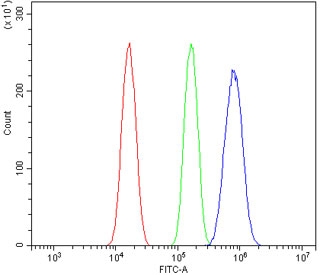
AHR (aryl hydrocarbon receptor), also called bHLHe76, is a member of the family of basic helix-loop-helix transcription factors. AHR is a cytosolic transcription factor that is normally inactive, bound to several co-chaperones. The AHR gene is mapped on 7p21.1. Estrogenic actions of AHR agonists were detected in wildtype ovariectomized mouse uteri, but were absent in Ahr-/- or Er-alpha -/- ovariectomized mice. Complex assembly and ubiquitin ligase activity of CUL4B(AHR) in vitro and in vivo are dependent on the AHR ligand. In the CUL4B(AHR) complex, ligand-activated AHR acts as a substrate-specific adaptor component that targets sex steroid receptors for degradation. Cd4-positive cells from mice lacking Ahr developed Th17 responses but failed to produce Il22 and did not show enhanced Th17 development. Activation of Ahr during induction of EAE accelerated disease onset and increased pathology in wildtype mice, but not in Ahr-/- mice. The TDO-AHR pathway is active in human brain tumors and is associated with malignant progression and poor survival. Ahr activity within ROR-gamma-t-positive ILC could be induced by dietary ligands such as those contained in vegetables of the family Brassicaceae.
Formulation
0.5mg/ml if reconstituted with 0.2ml sterile DI water
Host
Rabbit
Immunogen Region
Recombinant rat protein (amino acids R15-Q196) was used as the immunogen for the Ah Receptor antibody.
Isotype
IgG
Predicted Reactivity
Mouse, Rat
Reactivity
Mouse, Rat
Recombinant
No
Antigen
Aryl Hydrocarbon Receptor
Uniprot
P41738
Buffer
Lyophilized from 1X PBS with 2% Trehalose and 0.025% sodium azide
Format
Antigen affinity purified
Purification
Affinity purified
Storage
After reconstitution, the Ah Receptor antibody can be stored for up to one month at 4°C. For long-term, aliquot and store at -20°C. Avoid repeated freezing and thawing.
Applications
Direct ELISA, FACS, WB
Dilution
Western blot: 0.5-1ug/ml,Flow cytometry: 1-3ug/million cells,Direct ELISA: 0.1-0.5ug/ml
 Loading ....