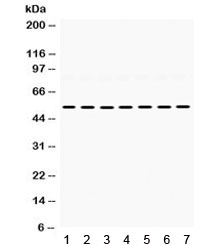
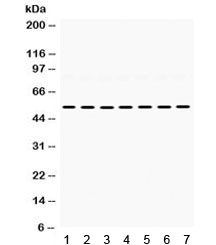
ADRA1A, also known as alpha-1A adrenergic receptor, is an alpha-1 adrenergic receptor, and also denotes the human gene encoding it. This gene is mapped to 8p21.2. Alpha-1-adrenergic receptors are G protein-coupled transmembrane receptors that mediate actions in the sympathetic nervous system through the binding of the catecholamines, epinephrine and norepinephrine. It has been found that ADRA1A transcripts in heart, brain, liver, and prostate. ADRA1A is the predominant ADRA1 subtype in liver and heart, and it can mediate the contraction of prostate smooth muscle.
Formulation
0.5mg/ml if reconstituted with 0.2ml sterile DI water
Host
Rabbit
Immunogen Region
Amino acids KAFQNVLRIQCLCRKQSSKHALGYTLHPPSQAVEGQHKD of human ADRA1A were used as the immunogen for the ADRA1A antibody.
Isotype
IgG
Predicted Reactivity
Human, Mouse, Rat
Reactivity
Rat, Human, Mouse
Recombinant
No
Antigen
ADRA1A
Uniprot
P35348
Format
Antigen affinity purified
Purification
Antigen affinity
Storage
After reconstitution, the ADRA1A antibody can be stored for up to one month at 4°C. For long-term, aliquot and store at -20°C. Avoid repeated freezing and thawing.
Applications
FACS, WB, IHC-P
Dilution
Western blot: 0.1-0.5ug/ml,Flow cytometry: 1-3ug/10^6 cells,Immunohistochemistry (FFPE): 1-2ug/ml
 Loading ....