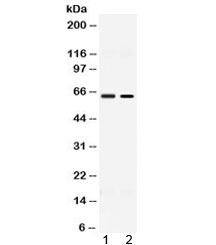
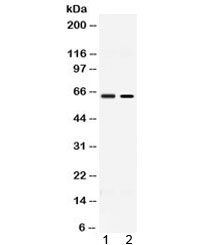
Amiloride-sensitive cation channel 1, neuronal, also known as ASIC2, is a protein that in humans is encoded by the ACCN1 gene. This gene encodes a member of the degenerin/epithelial sodium channel (DEG/ENaC) superfamily. The members of this family are amiloride-sensitive sodium channels that contain intracellular N and C termini, 2 hydrophobic transmembrane regions, and a large extracellular loop, which has many cysteine residues with conserved spacing. The member encoded by this gene may play a role in neurotransmission. In addition, a heteromeric association between this member and acid-sensing (proton-gated) ion channel 3 has been observed to co-assemble into proton-gated channels sensitive to gadolinium. Alternative splicing has been observed at this locus and two variants, encoding distinct isoforms, have been identified.
Formulation
0.5mg/ml if reconstituted with 0.2ml sterile DI water
Host
Rabbit
Immunogen Region
Amino acids 112-147 (ELLALLDVNLQIPDPHLADPSVLEALRQKANFKHYK from the human protein were used as the immunogen for the ACCN1 antibody.
Isotype
IgG
Predicted Reactivity
Human, Rat
Reactivity
Rat, Human
Recombinant
No
Subcellular Location
Cytoplasmic
Antigen
ACCN1
Uniprot
Q16515
Buffer
Lyophilized from 1X PBS with 2.5% BSA and 0.025% sodium azide
Format
Antigen affinity purified
Purification
Antigen affinity
Storage
After reconstitution, the ACCN1 antibody can be stored for up to one month at 4°C. For long-term, aliquot and store at -20°C. Avoid repeated freezing and thawing.
 Loading ....