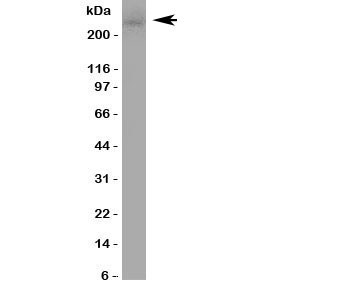
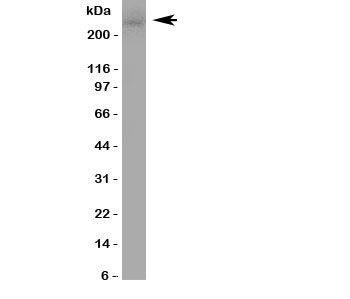
ATP-Binding Cassette, Subfamily A, Member 4, also known as ABCR, is a protein which in humans is encoded by the ABCA4 gene. It is a member of the ATP-binding cassette transporter gene sub-family A(ABC1) found exclusively in multicellular eukaryotes. Using a whole genome radiation hybrid panel, Allikmets et al.(1997) mapped the gene to 1p21-p13. Allikmets et al.(1997) localized ABCR transcripts exclusively within photoreceptor cells, indicating that ABCR mediates the transport of an essential molecule(or ion) either into or out of photoreceptor cells. Molday et al.(2000) showed by immunofluorescence microscopy and Western blot analysis that ABCR is present in foveal and peripheral cone, as well as rod, photoreceptors. The results suggested that the loss in central vision experienced by patients with Stargardt macular dystrophy arises directly from ABCR-mediated foveal cone degeneration.
Formulation
0.5mg/ml if reconstituted with 0.2ml sterile DI water
Host
Rabbit
Immunogen Region
An amino acid sequence from the C-terminus of mouse ABCA4 (TLLIQHHFFLTR) was used as the immunogen for this ABCA4 antibody (100% rat homology).
Isotype
IgG
Predicted Reactivity
Mouse, Rat
Reactivity
Rat, Mouse
Recombinant
No
Antigen
ABCA4
Uniprot
O35600
Buffer
Lyophilized from 1X PBS with 2% Trehalose
Format
Antigen affinity purified
Purification
Antigen affinity
Storage
After reconstitution, the ABCA4 antibody can be stored for up to one month at 4°C. For long-term, aliquot and store at -20°C. Avoid repeated freezing and thawing.
 Loading ....