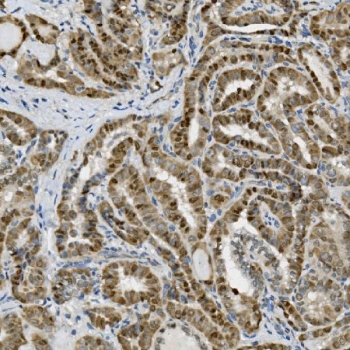
Transketolase is a thiamine-dependent enzyme that links the pentose phosphate pathway with the glycolytic pathway. The pentose phosphate pathway, which is active in most tissues, provides sugar phosphates for intermediary biosynthesis, especially nucleotide metabolism, and generates the biosynthetic reducing power for the cell in the form of NADPH. Transketolase is directly involved in the branch of the pathway that channels excess sugar phosphates to glycolysis, enabling the production of NADPH to be maintained under different metabolic conditions. NADPH is critical for maintaining cerebral glutathione, and thus it is likely that transketolase plays an important role in brain metabolism.
Formulation
0.5mg/ml if reconstituted with 0.2ml sterile DI water
Host
Mouse
Immunogen Region
A human recombinant partial protein (amino acids M1-A116) was used as the immunogen for the Transketolase antibody.
Isotype
IgG2b
Predicted Reactivity
Human, Mouse, Rat
Reactivity
Mouse, Rat, Human
Recombinant
No
Subcellular Location
Nuclear, cytoplasmic
Antigen
TKT
Uniprot
P29401
Clone No
2I3
Format
Antigen affinity purified
Purification
Affinity purified
Storage
After reconstitution, the Transketolase antibody can be stored for up to one month at 4°C. For long-term, aliquot and store at -20°C. Avoid repeated freezing and thawing.
Applications
IHC-P, IF, WB, FACS
Dilution
Western blot: 1-2ug/ml,Immunohistochemistry (FFPE): 2-5ug/ml,Immunofluorescence: 5ug/ml,Flow cytometry: 1-3ug/million cells
 Loading ....