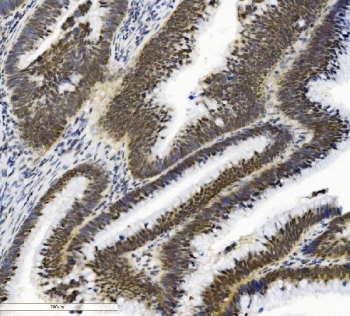
Smad2 (Mothers against decapentaplegic homolog 2), also known as MADR2, MADH2, SMAD family member 2 or SMAD2, is a protein that in humans is encoded by the SMAD2 gene. MAD homolog 2 belongs to the SMAD, a family of proteins similar to the gene products of the Drosophila gene 'mothers against decapentaplegic' (Mad) and the C. elegans gene Sma. Eppert et al. mapped the MADR2 gene close to DPC4 at 18q21, a region which is frequently deleted in colorectal cancers. Riggins et al. mapped the human MADH2 gene to 18q21. Nakao et al. refined the localization of the SMAD2 gene to 18q21.1, approximately 3 Mb proximal to DPC4, by fluorescence in situ hybridization. SMAD2 mediates the signal of the transforming growth factor (TGF)-beta, and thus regulates multiple cellular processes, such as cell proliferation, apoptosis, and differentiation. This protein is recruited to the TGF-beta receptors through its interaction with the SMAD anchor for receptor activation (SARA) protein. In response to TGF-beta signal, this protein is phosphorylated by the TGF-beta receptors.
Formulation
0.5mg/ml if reconstituted with 0.2ml sterile DI water
Host
Mouse
Immunogen Region
Recombinant human protein (amino acids E83-Q264) was used as the immunogen for the SMAD2 antibody.
Isotype
IgG1
Predicted Reactivity
Human
Reactivity
Human
Recombinant
No
Subcellular Location
Nuclear, cytoplasmic
Antigen
SMAD2
Uniprot
Q15796
Clone No
3C4
Buffer
Lyophilized from 1X PBS with 2% Trehalose
Format
Purified
Purification
Antigen affinity purified
Storage
After reconstitution, the SMAD2 antibody can be stored for up to one month at 4°C. For long-term, aliquot and store at -20°C. Avoid repeated freezing and thawing.
Applications
IHC-P, WB, FACS
Dilution
Western blot: 0.5-1ug/ml,Immunohistochemistry (FFPE): 2-5ug/ml,Flow cytometry: 1-3ug/million cells
 Loading ....