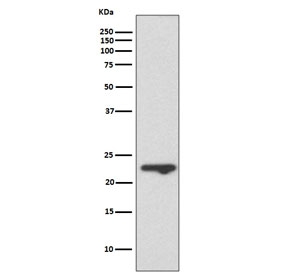
The MUC1 gene encodes a membrane-bound protein that is a member of the mucin family. Mucins are O-glycosylated proteins that play an essential role in forming protective mucous barriers on epithelial surfaces. These proteins also play a role in intracellular signaling. This protein is expressed on the apical surface of epithelial cells that line the mucosal surfaces of many different tissues including lung, breast stomach and pancreas. This protein is proteolytically cleaved into alpha and beta subunits that form a heterodimeric complex. The N-terminal alpha subunit functions in cell-adhesion and the C-terminal beta subunit is involved in cell signaling. Overexpression, aberrant intracellular localization, and changes in glycosylation of this protein have been associated with carcinomas. This gene is known to contain a highly polymorphic variable number tandem repeats (VNTR) domain. (RefSeq)
Formulation
Antibody in PBS with 0.02% sodium azide and 50% glycerol
Host
Rabbit
Immunogen Region
A synthetic peptide specific to the C-terminal region (beta subunit) of human MUC1 / Mucin-1 was used as the immunogen for the Mucin-1 antibody.
Isotype
IgG
Predicted Reactivity
Human
Reactivity
Human
Recombinant
No
Antigen
MUC1
Uniprot
P15941
Clone No
FHA-13
Format
Purified
Purification
Affinity purified
Storage
Store the Mucin-1 antibody at -20°C.
Applications
IHC-P, WB
Dilution
Western blot: 1:1000-1:2000,Immunohistochemistry (FFPE): 1:50-1:200
 Loading ....