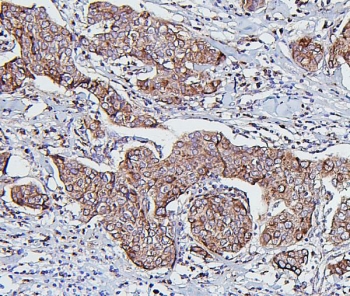
HSP60 is a member of the chaperonin class of protein factors, which include the Escherichia coli groEL protein and the Rubisco subunit-binding protein of chloroplasts. It acts as a costimulator of human regulatory CD4-positive/CD25 -positive T cells, which inhibit lymphoproliferation and IFNG and TNF secretion by CD4-positive and CD8-positive T cells. HSP60 enhances Treg activity via TLR2, leading to activation of an intracellular signaling cascade that included p38, as well as inhibition of ERK phosphorylation. Suppression of target T cells is mediated by both cell-to-cell contact and by secretion of TGFB and IL10, and it leads to downregulation of ERK, NFKB, and TBET expression. The self-molecule HSP60 can downregulate adaptive immune responses by upregulating Tregs through TLR2 signaling.
Formulation
0.5mg/ml if reconstituted with 0.2ml sterile DI water
Host
Mouse
Immunogen Region
A human recombinant protein (amino acids A260-Q496) was used as the immunogen for the Hsp60 antibody.
Isotype
IgG1
Predicted Reactivity
Human, Mouse, Rat
Reactivity
Human, Mouse, Rat
Recombinant
No
Antigen
HSP60
Uniprot
P10809
Clone No
6G2
Buffer
Lyophilized from 1X PBS with 2% Trehalose and 0.025% sodium azide
Format
Antigen affinity purified
Purification
Affinity purified
Storage
After reconstitution, the Hsp60 antibody can be stored for up to one month at 4°C. For long-term, aliquot and store at -20°C. Avoid repeated freezing and thawing.
Applications
FACS, IHC-P, WB
Dilution
Western blot: 0.5-1ug/ml, Immunohistochemistry (FFPE): 1-2ug/ml, Flow cytometry: 1-3ug/million cells
 Loading ....