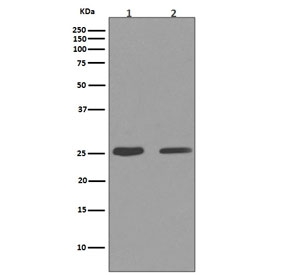
The main role of PARP (found in the cell nucleus) is to detect and initiate an immediate cellular response to metabolic, chemical, or radiation-induced single-strand DNA breaks (SSB) by signaling the enzymatic machinery involved in the SSB repair. (Wiki) Cleavage of PARP, by enzymes such as caspases or cathepsins, typically inactivates PARP. While in vitro cleavage by caspase occurs throughout the caspase family, preliminary data suggest that caspase-3 and caspase-7 are responsible for in vivo cleavage. Cleavage occurs at aspartic acid 214 and glycine 215, separating PARP into a 24kDA and 89kDA segment. The smaller moiety includes the zinc finger motif requisite in DNA binding. The 89 kDa fragment includes the auto-modification domain and catalytic domain. (Wiki)
Formulation
Antibody in PBS with 0.02% sodium azide and 50% glycerol
Host
Rabbit
Immunogen Region
A synthetic peptide specific to human PARP (24kDa cleavage segment) was used as the immunogen for the Cleaved PARP antibody.
Isotype
IgG
Predicted Reactivity
Human, Mouse
Reactivity
Human, Mouse
Recombinant
No
Antigen
Cleaved PARP1
Uniprot
P09874
Clone No
HI-16
Format
Purified
Purification
Affinity purified
Storage
Store the Cleaved PARP antibody at -20°C.
Applications
IHC-P, WB
Dilution
Western blot: 1:500-1:2000,Immunohistochemistry (FFPE): 1:50-1:100
 Loading ....