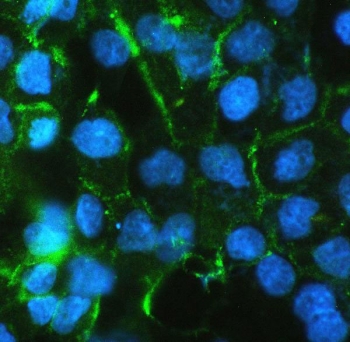
Catenins are proteins found in complexes with cadherin cell adhesion molecules of animal cells. The first two catenins that were identified became known as alpha-catenin and beta-catenin. Alpha-catenin can bind to beta-catenin and can also bind actin. Beta-catenin binds the cytoplasmic domain of some cadherins. Beta-catenin is an adherens junction protein. It plays an important role in various aspects of liver biology including liver development (both embryonic and postnatal), liver regeneration following partial hepatectomy. HGF-induced hepatpomegaly, liver zonation, and pathogenesis of liver cancer.
Formulation
0.5mg/ml if reconstituted with 0.2ml sterile DI water
Host
Mouse
Immunogen Region
Human beta Catenin recombinant protein (amino acids A2-K233) was used as the immunogen for the Beta Catenin antibody.
Lyophilized from 1X PBS with 2% Trehalose and 0.025% sodium azide
Format
Purified
Purification
Protein G affinity
Storage
After reconstitution, the Beta Catenin antibody can be stored for up to one month at 4°C. For long-term, aliquot and store at -20°C. Avoid repeated freezing and thawing.
Applications
FACS, IF, ICC, IHC-P, WB
Dilution
Western blot: 0.5-1ug/ml,Immunohistochemistry (FFPE): 1-2ug/ml,Immunocytochemistry: 2-4ug/ml,Immunofluorescence: 2-4ug/ml,Flow cytometry: 1-3ug/million cells
 Loading ....