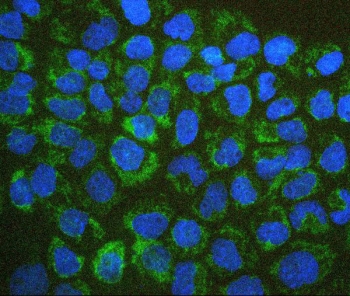
BAK, officially called Bcl2 antagonist killer, is a protein that in humans, encoded by the BAK gene. The BAK protein is a pro-apoptotic member of the Bcl-2 gene family which is involved in initiating apoptosis. BAK gene spans 7.6 kb and contains 6 exons. By Southern blot analysis of genomic DNA from human/rodent somatic cell hybrids, BAK gene is localized to chromosome 6. This protein localizes to mitochondria, and functions to induce apoptosis. It interacts with and accelerates the opening of the mitochondrial voltage-dependent anion channel, which leads to a loss in membrane potential and the release of cytochrome. This protein also interacts with the tumor suppressor P53 after exposure to cell stress.
Formulation
0.5mg/ml if reconstituted with 0.2ml sterile DI water
Host
Mouse
Immunogen Region
A human recombinant protein (amino acids A22-S211) was used as the immunogen for the BAK1 antibody.
Isotype
IgG2b
Predicted Reactivity
Human, Mouse, Rat
Reactivity
Mouse, Rat, Human
Recombinant
No
Antigen
BAK1
Uniprot
Q16611
Clone No
4C2
Buffer
Lyophilized from 1X PBS with 2% Trehalose and 0.025% sodium azide
Format
Antigen affinity purified
Purification
Affinity purified
Storage
After reconstitution, the BAK1 antibody can be stored for up to one month at 4°C. For long-term, aliquot and store at -20°C. Avoid repeated freezing and thawing.
 Loading ....