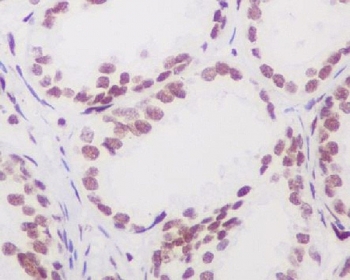
The androgen receptor gene is more than 90 kb long and codes for a protein that has 3 major functional domains: the N-terminal domain, DNA-binding domain, and androgen-binding domain. The protein functions as a steroid-hormone activated transcription factor. Upon binding the hormone ligand, the receptor dissociates from accessory proteins, translocates into the nucleus, dimerizes, and then stimulates transcription of androgen responsive genes. This gene contains 2 polymorphic trinucleotide repeat segments that encode polyglutamine and polyglycine tracts in the N-terminal transactivation domain of its protein. Expansion of the polyglutamine tract from the normal 9-34 repeats to the pathogenic 38-62 repeats causes spinal bulbar muscular atrophy (SBMA, also known as Kennedy's disease). Mutations in this gene are also associated with complete androgen insensitivity (CAIS). Alternative splicing results in multiple transcript variants encoding different isoforms. (RefSeq)
Formulation
Antibody in PBS with 0.02% sodium azide and 50% glycerol
Host
Rabbit
Immunogen Region
A synthetic peptide specific to human Androgen Receptor was used as the immunogen for the Androgen Receptor antibody.
Isotype
IgG
Predicted Reactivity
Human
Reactivity
Human
Recombinant
No
Subcellular Location
Cytoplasmic, nuclear
Antigen
Androgen Receptor
Uniprot
P10275
Clone No
CDF-1
Format
Purified
Purification
Affinity purified
Storage
Store the Androgen Receptor antibody at -20°C.
Applications
IHC-P, WB
Dilution
Western blot: 1:500-1:2000,Immunohistochemistry (FFPE): 1:50-1:200
 Loading ....