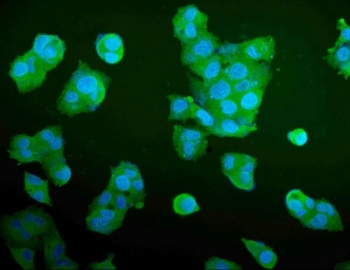
Aldolase A (ALDOA, or ALDA), also known as fructose-bisphosphate aldolase, is an enzyme that in humans is encoded by the ALDOA gene on chromosome 16. This gene encodes a member of the class I fructose-bisphosphate aldolase protein family. The encoded protein is a glycolytic enzyme that catalyzes the reversible conversion of fructose-1,6-bisphosphate to glyceraldehyde 3-phosphate and dihydroxyacetone phosphate. Three aldolase isozymes (A, B, and C), encoded by three different genes, are differentially expressed during development. Mutations in this gene have been associated with Glycogen Storage Disease XII, an autosomal recessive disorder associated with hemolytic anemia. Disruption of this gene also plays a role in the progression of multiple types of cancers. Related pseudogenes have been identified on chromosomes 3 and 10.
Formulation
0.5mg/ml if reconstituted with 0.2ml sterile DI water
Host
Mouse
Immunogen Region
A human recombinant partial protein (amino acids E50-Y364) was used as the immunogen for the ALDOA antibody.
Isotype
IgG2b
Predicted Reactivity
Human
Reactivity
Human
Recombinant
No
Antigen
Aldolase A
Uniprot
P04075
Clone No
6H8
Format
Antigen affinity purified
Purification
Affinity purified
Storage
After reconstitution, the ALDOA antibody can be stored for up to one month at 4°C. For long-term, aliquot and store at -20°C. Avoid repeated freezing and thawing.
Applications
FACS, IF, IHC-P, WB
Dilution
Western blot: 1-2ug/ml,Immunohistochemistry (FFPE): 2-5ug/ml,Immunofluorescence: 5ug/ml,Flow cytometry: 1-3ug/million cells
 Loading ....