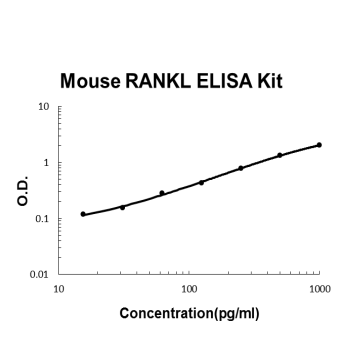
Mouse TNFSF11/RANKL ELISA Kit PicoKine® (96 Tests). Quantitate Mouse Tnfsf11 in cell culture supernatants, cell lysates, serum and plasma (heparin, EDTA). Sensitivity: 10pg/ml. The brand Picokine indicates this is a premium quality ELISA kit. Each Picokine kit delivers precise quantification, high sensitivity, and excellent reproducibility. Only our most reliable and effective kits qualify as Picokine, guaranteeing top-tier results for your assays.
Alternative Names
Tumor necrosis factor ligand superfamily member 11;Osteoclast differentiation factor;ODF;Osteoprotegerin ligand;OPGL;Receptor activator of nuclear factor kappa-B ligand;RANKL;TNF-related activation-induced cytokine;TRANCE;CD254;Tumor necrosis factor ligand superfamily member 11, membrane form;Tumor necrosis factor ligand superfamily member 11, soluble form;Tnfsf11;Opgl, Rankl, Trance;
Molecular Weight
35003 MW
Immunogen
Expression system for standard: NS0; Immunogen sequence: R72-D316
Cytokine that binds to TNFRSF11B/OPG and to TNFRSF11A/RANK. Osteoclast differentiation and activation factor. Augments the ability of dendritic cells to stimulate naive T-cell proliferation. May be an important regulator of interactions between T-cells and dendritic cells and may play a role in the regulation of the T-cell-dependent immune response. May also play an important role in enhanced bone-resorption in humoral hypercalcemia of malignancy.
Background
Receptor activator of nuclear factor kappa-B ligand (RANKL), also known as tumor necrosis factor ligand superfamily member 11 (TNFSF11), is a protein that in humans is encoded by the TNFSF11 gene. This gene encodes a member of the tumor necrosis factor (TNF) cytokine family which is a ligand for osteoprotegerin and functions as a key factor for osteoclast differentiation and activation. This gene is mapped to chromosome13q14.11. Targeted disruption of the related gene in mice led to severe osteopetrosis and a lack of osteoclasts. The deficient mice exhibited defects in early differentiation of T and B lymphocytes, and failed to form lobulo-alveolar mammary structures during pregnancy. This gene may play an important role in enhanced bone-resorption in humoral hypercalcemia of malignancy.
Reproducibility
Lots
Lot 1 (pg/ml)
Lot 2 (pg/ml)
Lot 3 (pg/ml)
Lot 4 (pg/ml)
Mean (pg/ml)
Standard Deviation
CV (%)
Sample 1
34
39
32
37
35
2.69
7.6%
Sample 2
195
191
201
186
193
5.49
2.8%
Sample 3
430
475
480
482
466
21.37
4.5%
*number of samples for each test n=16.
Notes
Material Required But Not Provided: Microplate Reader capable of reading absorbance at 450nm. Incubator. Automated plate washer . Pipettes and pipette tips capable of precisely dispensing 0.5 µl through 1 ml volumes of aqueous solutions. Multichannel pipettes are recommended for large amount of samples. Deionized or distilled water. 500ml graduated cylinders. Test tubes for dilution.
Gene ID
21943
Antigen
TNFSF11/RANKL
Gene Name
TNFSF11
UniProt ID
O35235
Protein Name
Tumor necrosis factor ligand superfamily member 11
Tissue Specificity
Highly expressed in thymus and lymph nodes, but not in non-lymphoid tissues and is abundantly expressed in T- cells but not in B-cells. A high level expression is also seen in the trabecular bone and lung.
Store at 4°C for 6 months, at -20°C for 12 months. Avoid multiple freeze-thaw cycles (Ships with gel ice, can store for up to 3 days in room temperature. Freeze upon receiving.)
Reviews of Mouse TNFSF11/RANKL ELISA Kit PicoKine®
 Loading ....