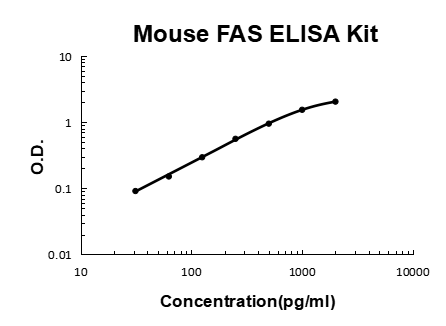
Mouse FAS/Cd95 ELISA Kit PicoKine® (96 Tests). Quantitate Mouse Fas in cell culture supernatants, serum and plasma (heparin, EDTA, citrate). Sensitivity: 3pg/ml. The brand Picokine indicates this is a premium quality ELISA kit. Each Picokine kit delivers precise quantification, high sensitivity, and excellent reproducibility. Only our most reliable and effective kits qualify as Picokine, guaranteeing top-tier results for your assays.
Alternative Names
Tumor necrosis factor receptor superfamily member 6 ;Fas ;
Molecular Weight
7116 MW
Immunogen
Expression system for standard: NS0; Immunogen sequence: Q22-R169
There is no detectable cross-reactivity with other relevant proteins.
Specificity
Natural and recombinant mouse FAS
Sample Type
Cell culture supernatants, Serum, Plasma
Anticoagulant
heparin, EDTA or citrate
Precision
Intra-Assay Precision
Inter-Assay Precision
Sample
1
2
3
1
2
3
n
16
16
16
24
24
24
Mean (pg/ml)
67
227
869
60
222
905
Standard deviation
3.35
14.07
63.43
3.66
17.76
70.59
CV (%)
5%
6.2%
7.3%
6.1%
8%
7.8%
Background
Fas, also known as APO-1, CD95 and TNFRSF6, is a member of the nerve growth factor (NGF)/tumour necrosis factor (TNF) receptor superfamily and mediates apoptosis. The nucleotide sequence of the cDNAs reveales that the molecule coding for the Fas antigen determinant is a 319 amino acid polypeptide with a single transmembrane domain. The extracellular domain is rich in cysteine residue, and shows a similarity to that of human tumor necrosis factor receptors, human nerve growth factor receptor, and human B cell antigen CD40. The APO-1 antigen as defined by the mouse monoclonal antibody anti-APO-1 is previously found to be expressed on the cell surface of activated human T and B lymphocytes and a variety of malignant human lymphoid cell lines. The APO-1 antigen is found to be a membrane glycoprotein of 48-kDa. Fas antigen is expressed and functional on papillary thyroid cancer cells and this may have potential therapeutic significance. Fas can play a role as an inducer of both neurite growth in vitro and accelerates recovery after nerve injury in vivo.
Reproducibility
Lots
Lot 1 (pg/ml)
Lot 2 (pg/ml)
Lot 3 (pg/ml)
Lot 4 (pg/ml)
Mean (pg/ml)
Standard Deviation
CV (%)
Sample 1
67
72
66
74
69
3.34
4.8%
Sample 2
227
219
205
237
222
11.7
5.2%
Sample 3
869
913
935
934
912
26.74
2.9%
*number of samples for each test n=16.
Notes
Material Required But Not Provided: Microplate Reader capable of reading absorbance at 450nm. Incubator. Automated plate washer . Pipettes and pipette tips capable of precisely dispensing 0.5 µl through 1 ml volumes of aqueous solutions. Multichannel pipettes are recommended for large amount of samples. Deionized or distilled water. 500ml graduated cylinders. Test tubes for dilution.
Gene ID
14102
Antigen
FAS/Cd95
Gene Name
FAS
UniProt ID
Q8C350
Protein Name
Tumor necrosis factor receptor superfamily member 6
Store at 4°C for 6 months, at -20°C for 12 months. Avoid multiple freeze-thaw cycles (Ships with gel ice, can store for up to 3 days in room temperature. Freeze upon receiving.)
 Loading ....